If You Still See Yourself as an Athlete but Have Not Trained in Years, Start Here
Every month I meet someone in their late 30s or 40s who says some version of this:
“I used to be really athletic.”
“I played in college.”
“I ran all the time.”
“I just need to get back into it.”
A few weeks later they are dealing with knee pain, Achilles irritation, back tightness, or a shoulder that will not calm down.
The issue is rarely motivation. It is not toughness. And it is not that they are “too old.”
The issue is that they are trying to return to sport without rebuilding the healthcare foundation that supports sport. That is where athletic training comes in.
What Athletic Training Actually Is
Athletic training is a recognized healthcare profession focused on the prevention, evaluation, treatment, and rehabilitation of musculoskeletal injuries, along with performance optimization.
Athletic trainers are trained in:
• Injury risk assessment
• Movement analysis
• Emergency care
• Orthopedic evaluation
• Rehabilitation programming
• Return to sport decision making
• Performance progression
We are not just sideline first responders. We are movement specialists who understand how the body adapts to load over time.
In your late 30s and 40s, especially if you have been less active for several years, that expertise becomes critical.
Why Former Athletes Get Hurt When They Come Back
Your identity may still be athletic. Your tissues may not be.
When you stop consistently training, your body gradually loses capacity. Muscle mass declines. Tendons become less tolerant of sudden load. Joint mobility decreases. Recovery slows.
Then life calms down a bit and you decide to get back in shape. You sign up for a race, a league, or a high intensity class. You train based on what you used to be able to do rather than what you are currently prepared to tolerate.
The gap between demand and capacity is what creates injury.
Athletic training exists to close that gap.
The Athletic Healthcare Paradigm at Variable Movement
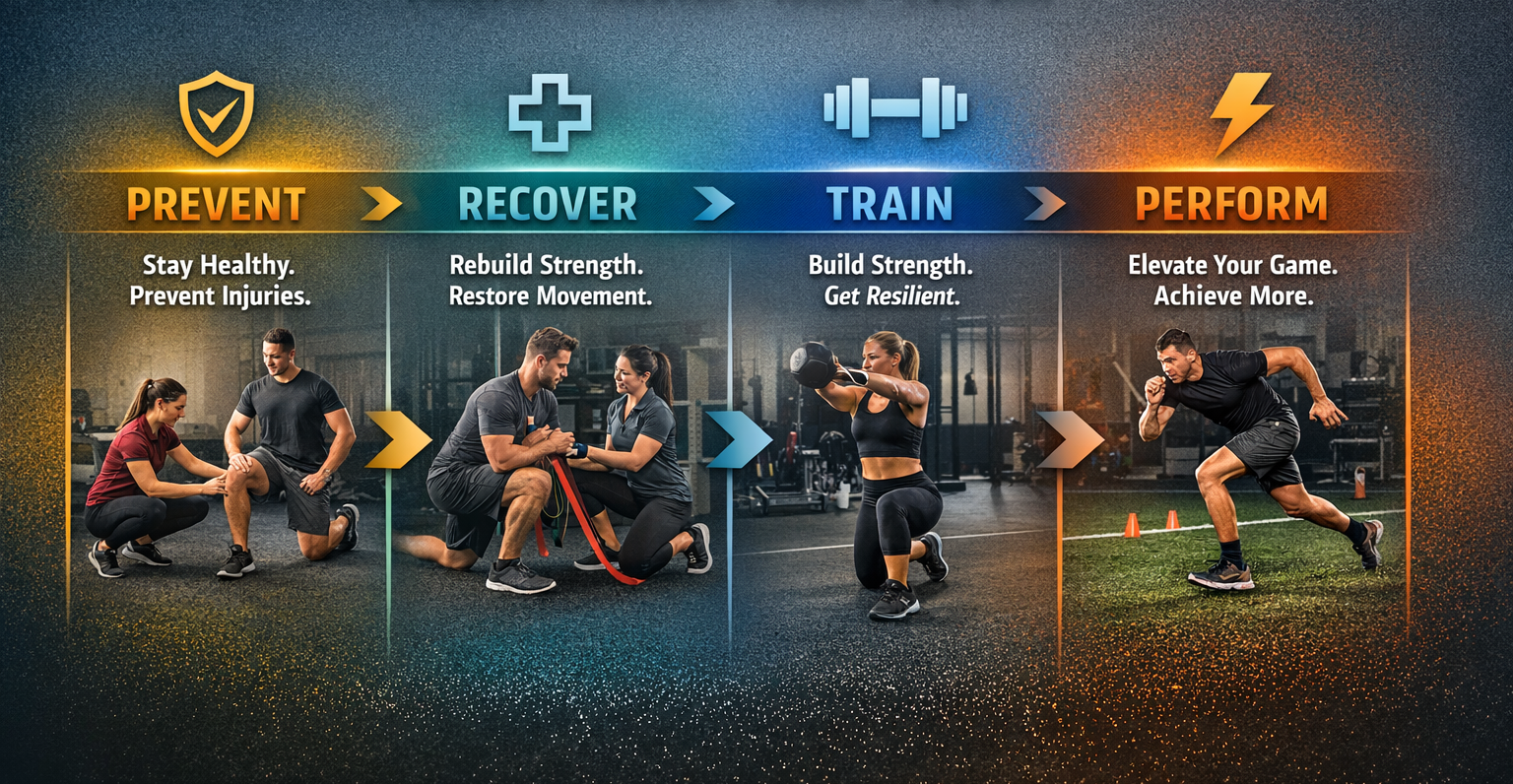
At Variable Movement, we do not separate healthcare from performance. We operate within what I call the full athletic healthcare paradigm.
Prevention
We begin with a comprehensive movement and strength assessment. We look at mobility restrictions, asymmetries, prior injuries, and strength deficits. We identify where you are most likely to break down before you break down.
Injury Recovery
If you are already dealing with pain, we treat the root cause, not just the symptom. That means restoring joint mobility, rebuilding tissue tolerance, and correcting movement patterns that overload certain structures. We use progressive strength and controlled loading to guide tissues back to resilience.
Performance
Once you are moving well and tolerating load, we transition into performance progression. That might mean return to running, rotational power for golf or tennis, explosive work for court sports, or strength development for longevity and bone density.
This continuum is seamless. Prevention, recovery, and performance are not separate silos. They are phases of the same process.
Why This Matters in Your 40s
In your 20s you could get away with inconsistency. In your 40s, durability becomes the priority.
The goal is not to survive a hard workout. The goal is to build a body that can handle consistent training for years. That requires intelligent progression, strategic strength training, and regular reassessment.
Athletic training provides structure to that process. It replaces guesswork with clinical reasoning. It respects your history while acknowledging your current baseline.
If You Still Call Yourself an Athlete
If you still call yourself an athlete but have not been athletic for a few years, see an athletic trainer.
Do not wait for the injury that forces you to slow down. Do not rely solely on generic programming that does not account for your movement history.
At Variable Movement, we believe athletic healthcare should span the entire spectrum from prevention to injury recovery to performance. Whether you are returning to running, getting back into strength training, or chasing a new competitive goal, the path forward should be guided.
You are not past your prime. You just need a structured return that respects physiology, not nostalgia.
That is what athletic training is built for.